Who is Eligible for Government Home Improvement Grant?

Have you ever been plagued by the thought of revamping your aging property but held back due to the cost associated? Worry not. The government home improvement grants could be your saving grace. These grants are designed to financially assist homeowners in renovating their properties.

However, the burning question that remains is, “Who is eligible for government home improvement grants?” Let’s delve into the topic and clarify the eligibility criteria in detail.

What is a Home Improvement Grant?

A home improvement grant is a form of financial assistance provided by the government to homeowners for renovating their properties. Unlike loans, these grants do not need to be repaid, making them particularly beneficial for property owners. They can be used for various improvements, including essential repairs and energy-efficiency upgrades. The grants are often targeted towards low-income homeowners, senior citizens, disabled individuals, and those living in rural areas or homes affected by natural disasters.

Who Qualifies for Home Improvement Grants?

While the allure of government home improvement grants is undeniable, they aren’t available to everyone. There are specific criteria that individuals must meet to qualify for these funds. Here are the key eligibility requirements:

Low-Income Homeowners

The primary target for these grants are low-income homeowners who can’t afford the cost of essential home improvements. Most programs have strict income limits, so make sure to check the specifics of each grant you’re considering.

How the Money Can Be Used

The grant money for low-income homeowners can be allocated for necessary home repairs, addressing safety issues, and other essential home improvements. This is crucial for maintaining a safe and habitable living environment.

How to Qualify:

  • Provide proof of income that falls below a specific threshold.
  • Must have valid documentation that confirms homeownership.

Senior Citizens and Disabled Individuals

Often, government home improvement grants prioritize senior citizens and disabled individuals. These grants focus on home modifications that increase accessibility and safety, such as adding ramps or handrails.

Section 504 Home Repair Program

This program specifically aids elderly and disabled individuals in making their homes safer and more accessible. It provides grants for repairs that remove health and safety hazards and may also offer loans for general home improvements. The program primarily targets those who struggle to afford necessary repairs due to low income.

Area Agency on Aging

This agency offers various services and support to senior citizens, including assistance with home improvements. They focus on enabling elderly individuals to live independently in their homes for as long as possible, often providing resources or information on obtaining home repair grants.

How the Money Can Be Used

For senior citizens and disabled individuals, the funds are intended for home modifications that enhance accessibility and safety, like installing ramps or safety rails.

How to Qualify:

  • Verification of age for senior citizens or proof of disability for disabled individuals.
  • Income must meet certain guidelines specified for the program.

Homeowners Eligible for Energy Efficiency Upgrades

Some grants are aimed specifically at homeowners looking to make their homes more energy-efficient. These may require an energy audit to confirm that the proposed changes would significantly reduce the home’s energy consumption.

How the Money Can Be Used

This category focuses on upgrades that improve a home’s energy efficiency, such as insulation or energy-efficient appliances.

How to Qualify:

  • A professional assessment of the home to identify potential areas for energy efficiency improvements.

Rural Residents

Many programs prioritize residents of rural areas, assisting those who may not have access to traditional financing options. The USDA’s Single Family Housing Repair Loans and Grants is an example of such a program.

How the Money Can Be Used

Rural residents can use the grant for a variety of home improvements, focusing on essential repairs and upgrades necessary for rural living conditions.

How to Qualify:

  • Proof of residency in an area classified as rural by the relevant governmental body.

Homeowners Affected by Natural Disasters

If your home has been damaged by a natural disaster, you may be eligible for a government home improvement grant. These grants are designed to help homeowners repair and rebuild after events like hurricanes, floods, or wildfires.

How the Money Can Be Used

These funds are allocated for repairing damages caused by natural disasters, aiding in restoring homes to safe living conditions.

How to Qualify:

  • Documentation or evidence showing the home was impacted by a natural disaster.

Veterans

Home improvement grants for veterans are designed to address the unique challenges and needs faced by those who have served in the military. These grants are particularly vital for disabled veterans, as they cater to the creation of accessible and safe living environments. They help in making essential modifications like installing ramps, widening doorways, and adapting bathrooms for better accessibility. These grants recognize the sacrifices veterans have made and provide them with the necessary support to improve their living conditions and overall quality of life.

Specially Adapted Housing (SAH)

SAH grants assist veterans with severe service-connected disabilities in building, remodeling, or purchasing an adapted home. These grants focus on creating a living space that accommodates the veteran’s disability.

Special Home Adaptation (SHA) Grants

SHA grants are available for veterans with specific service-connected disabilities. These grants can be used to adapt an existing home to meet their needs, focusing on mobility and functionality within the home.

Temporary Residence Adaptation Grants

These grants are for veterans with service-connected disabilities. They allow for modifications to a temporary residence, often the home of a family member, to make it more accessible.

How the Money Can Be Used

The funds can be allocated for modifications to improve accessibility and safety, especially for disabled veterans, and for general home repairs.

How to Qualify:

  • Proof of military service.
  • Disability status for certain grants.

Native Americans

Home improvement grants for Native Americans are tailored to meet the specific needs of Native American communities. These grants aim to improve living conditions, preserve cultural heritage, and ensure safe and healthy living environments. They often focus on essential home repairs and upgrades, particularly in tribal areas or designated Native American lands. The intention is to support the preservation and improvement of housing within these communities, respecting and acknowledging their unique cultural and historical context.

Housing Improvement Program (HIP)

The HIP is designed to help Native Americans with housing needs. This program assists in repairing, renovating, or replacing existing housing and in some cases, can help in the construction of new housing. It’s particularly aimed at those living in substandard housing conditions and is a vital resource for improving the quality of living and housing stability in Native American communities.

How the Money Can Be Used

Grants can be used for essential home repairs, improvements, and upgrades to enhance living conditions.

How to Qualify:

  • Membership in a recognized Native American tribe.
  • Residing on tribal land or meeting specific criteria.

How to Apply for a Grant?

Once you’ve determined that you meet the eligibility requirements for a government home improvement grant, the next step is to apply. The application process varies depending on the grant. However, it typically involves submitting an application form along with necessary documents proving your eligibility. It’s essential to carefully read the application guidelines and provide all requested information to increase your chances of approval.

Additional Eligibility Considerations

As you further explore the realm of government home improvement grants, there are additional eligibility factors you may need to consider.

Property Location

Some grants are only available to homeowners in certain states or counties. Therefore, your location can significantly affect your eligibility.

Property Type

The type of property you own might also influence your eligibility. Single-family homes, multi-family homes, manufactured homes, and condos have different grant programs with distinct eligibility requirements.

Military Status

Special grants are available for veterans and active-duty military personnel. These grants help adapt homes to accommodate service-related disabilities.

Tribal Membership

Tribal members may be eligible for specific grants aimed at improving housing conditions in tribal areas.

Historical Homes

If your home is on a historic registry, you may qualify for a grant to help preserve its historic integrity while making necessary improvements.

Getting the Most from Government Home Improvement Grants

Meeting the eligibility requirements is one thing, but to maximize your chances of receiving a grant, you should:

Provide Complete Information

Incomplete applications are one of the most common reasons for grant rejections. Make sure you thoroughly fill out all application sections and provide all required documentation.

Apply Early

These grants are often awarded on a first-come, first-served basis. Therefore, applying early increases your chances of securing a grant.

Use Grant-Specific Language

Align your application with the grant’s mission and use relevant language that shows your understanding of the program.

Explore Multiple Options

Don’t limit yourself to applying for just one grant. There are numerous programs available, and applying for multiple grants could increase your chances of getting funding.

Expanding Housing Opportunities

The National Residential Improvement Association, along with various initiatives like the Home Investment Partnership Program and support from state and local governments, plays a pivotal role in expanding housing opportunities. These efforts focus on providing home improvement loans and grants, especially targeting health or safety hazards.

They strive to create affordable housing options and assist very low-income homeowners to obtain affordable credit. Cash-out refinance is another tool used to fund home improvement projects, ensuring that homes are safe and accessible for all.

Conclusion

Government-sponsored financial aid, such as home repair grants, can provide the lifeline eligible homeowners need to address health and safety hazards in their homes. Home improvement grant programs funded by the federal government offer an avenue to turn around affordable housing plagued by health and safety issues, breathing new life into properties and enhancing the quality of life for residents. Whether you’re dealing with much-needed home repairs, seeking accessibility improvements, or focused on improving energy efficiency, there is a grant program tailored to meet your specific needs.

The diversity of these programs, whether managed by federal agencies like the Department of Housing and Urban Development, or designed for residents of an approved tribal service area, reflects the broad commitment of the government to assist homeowners in their home improvement projects. These grant monies can be a game-changer for homeowners, especially those in dire need of home repair, yet burdened by financial constraints.

Remember, no home should be a source of anxiety. With these home improvement grant programs, the dream of converting your property into a secure, comfortable, and energy-efficient haven can be achieved. The road to transforming your home might seem daunting, but remember, a safer and revitalized living environment is not beyond your reach.

What Commission Percentage Do Real Estate Agents Make?

It’s common knowledge that real estate agents make a commission percentage from the sale or purchase of a home. But rates can be negotiated and vary based on the broker, the price point of the home, the market and other factors.

Keep reading for a detailed explanation of how commission fees work, answers to common commission questions, and various ways sellers and home buyers can save on commission rates and closing costs.

What Commission Do Realtors Make?

While the total amount of commission that agents receive is based on a percentage, the exact percentage varies across markets. Nationally, home sellers can generally expect to pay about 5.75% of a home’s final sales price in total commissions.

In many markets, a total commission of 5.25% or even 5.0% is common, while other markets may see 6% across the board. Whether it’s 5%, 6% or somewhere in between, the final amount is typically split between the listing agent and buyer agent and represents the median commission rate in the US. Each agent then pays a “split” to the sponsoring broker, depending on the compensation structure of the brokerage.

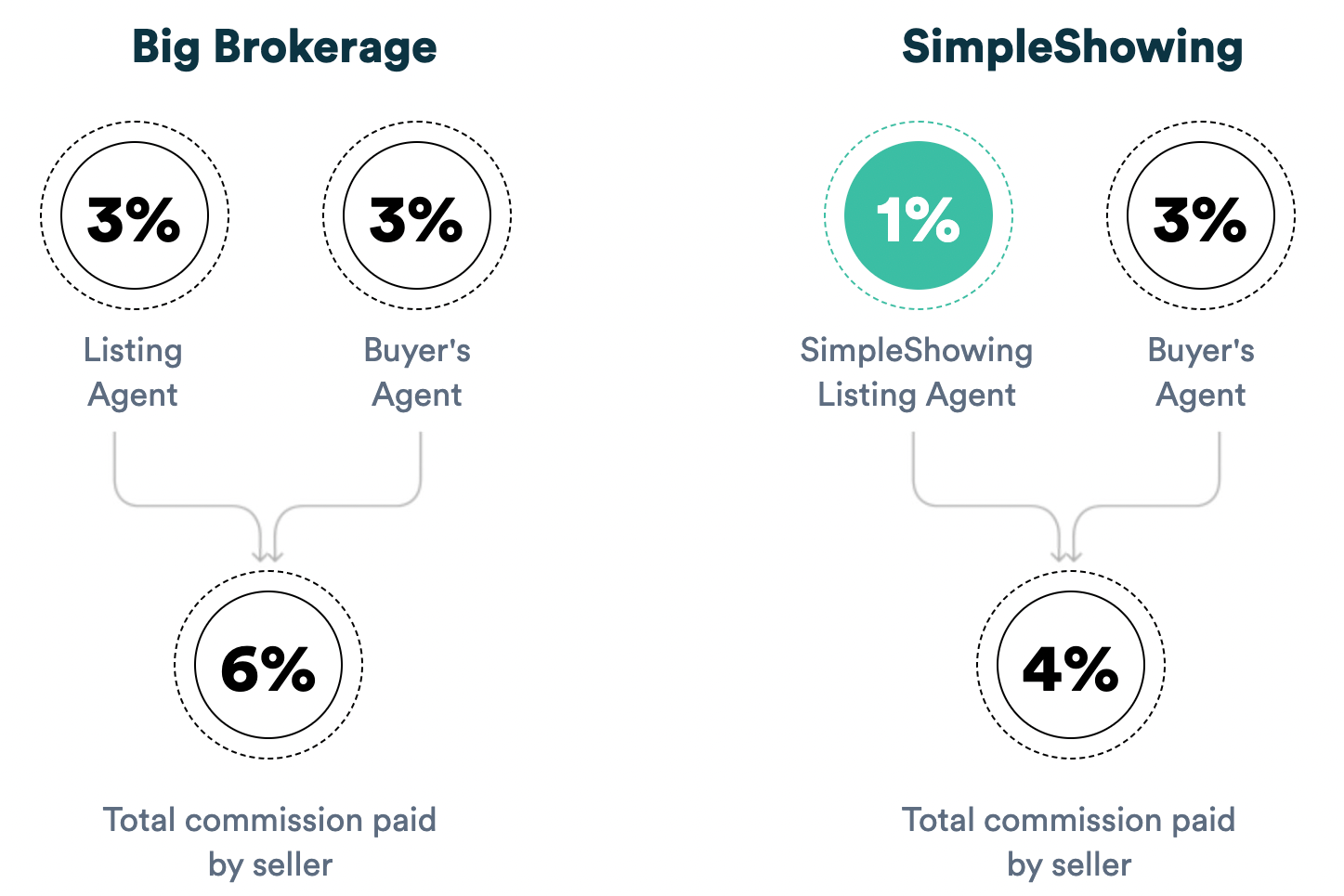
Nationwide, most big, national brokerages charge a total 6% commission rate.

In this structure, the listing agent will keep half of the proceeds (typically between 2.5% and 3%), and then give the other half of the proceeds to the buyer’s agent.

Say you sold your home for $300,000 and worked with a listing agent with a 6% commission fee. After the sale of the home, your listing agent would earn $18,000 back in commissions. That profit would then be split with the buyer’s agent leaving each with $9,000 in profits.

As mentioned, it should be noted that while the national average for commission percentages sits between 5% and 6%, that is not necessarily the case for all agents. Some may charge higher and others lower. Some independent brokerages, such as SimpleShowing, offer sellers a low 1% listing fee. Do your research and shop around to find an agent whose commission model works best for you.

Who Pays the Agents?

Generally, real estate agents are paid by the seller. This money comes out of the proceeds generated from the sale of the home. The full 5-6% commission of the home is combined for simplicity. The listing agent will keep a portion of the profits while the other portion is given to the buyer’s agent.

Generally, the split is 50-50, meaning the listing agent keeps half of the total commission and buyer’s agent keeps the other half. For example, if the total commission is 5%, each agent would receive 2.5% of the final sales price of the home. For a $600,000 property, this would be $15,000 for each agent.

You might be wondering “why would the seller pay the fee for the buyer agent?” While it may initially seem strange that the seller would pay both, it’s important to note that it’s a bit more nuanced than it sounds. The buyer agent’s commission fee is factored into the listed price of the home.

In other words, if there was no buyer agent involved, it’s feasible that the home seller might sell the home for 2-3% less than the asking price, since they wouldn’t have to compensate a buyer agent.

If you sell your home for $500,000 and pay a total of 6% in commission, you will actually only actually receive $470,000 back after you pay the agent commissions (excluding other possible closing costs).

Do Realtors Keep the Full Commission?

As much as agents would love to receive their full portion of their sale, commission fees don’t usually work that way. Agents rarely work independently, but instead through a brokerage. A brokerage refers to the company they represent and whose branding is on their advertising material. Brokerages provide support for the agent and pays for expenses associated with real estate transactions.

In return for all that they provide, agents are required to give a certain percentage of their commissions back to the brokers. This percentage is often 5%-20% of the commission received for large, national brands like Keller Williams and ReMax. This percentage could vary depending on how long the agent has been working with the brokerage or if the agent has “capped” out by paying the broker a predefined amount. On the other hand, there are brokerages where the agent gets to keep 100% of your commission and own your brand.

Can You Negotiate Realtor Commissions?

While Realtors certainly deserve compensation for the work they do, keep in mind that most of the time you can negotiate the commission rate with your agent or find ways to lower or offset the commission fees.

In some situations, sellers may be able to negotiate commission percentages. This includes when home sellers using the same agent to sell their current home and then again buy a new one – similar to a loyalty discount.

Some agents also give discounted rates to repeat clients and investors that buy/sell multiple properties.

Another scenario that represents an opportunity to save on commission is when there is only one agent involved during a home sale. For example, if you are selling your home and the buyer does not bring an agent into the transaction, only one agent is involved. This represents an opportunity to potentially save up to 3% (or half the total commission).

Lastly, many buyer agents will kick back a portion of the commission to the home buyer their clients in the form of a consumer rebate – which is surprisingly encouraged by the United States DOJ. In this scenario, savvy home buyers could get rewarded with a commission refund for performing showings on their own or leveraging the agent on a limited basis.

Try Independent Brokers like SimpleShowing

If you simply want to save money on the sale or purchase of your home, a low commission real estate agent might be your best bet.

With SimpleShowing, sellers save thousands with a 1% listing fee that automatically lowers total commission to just 4% instead of 6%. Not only that, but you will get the same exceptional service and features of a mega brokerage.

If you’re looking to buy a home, you are in luck too. With the SimpleShowing Buyer Refund, home buyers can also receive a portion of their agents commission at closing. Whether you are buying or selling, just imagine what you could do with that extra cash in your pocket. Contact SimpleShowing today to connect with a local agent.

Final Thoughts

Understanding the agent’s commission is crucial for both the seller and potential buyers engaging in real estate transactions. Real estate agent commissions, guided by standards set by the National Association of Realtors, play a pivotal role in agent-assisted home sales. Experienced agents involved in these transactions typically share the commission, which is a percentage of the home’s final sale price. This commission is not just a fee but a reflection of the value and expertise that real estate professionals bring to the table.

It’s essential to recognize that the final sale price of a home is influenced by the efforts of these professionals, ensuring that all parties involved, including both the seller and potential buyers, receive fair and expert representation. The dynamics of real estate commission underline the importance of understanding the nuances of these fees. When a home sells, the selling agent and the buyer’s agent, both integral to the transaction, share the commission.

This cost, while seemingly an additional expense, is justified by the comprehensive services and market knowledge provided by these agents. The real estate market thrives on the expertise of these professionals, ensuring that the complexities of buying or selling a home are navigated with skill and proficiency. Remember, the agents involved are not just facilitators but key players in achieving successful real estate deals, making their commission a worthy investment for a successful outcome.

Should You Sell Your House to a Friend?

Whenever you’re facing a large financial decision like selling your home, things rarely go 100% smoothly.

In some scenarios, you might have a friend or neighbor who hear that you’re moving and want to buy your home from you.

Now, this may sound like the easier route since you won’t have to list your home, deal with staging or manage showings. However, there are still many steps involved that can cause your relationship to get messy.

Before you move forward with this decision, consider the advantages and disadvantages to decide if you should sell your house to a friend.

Advantages and Disadvantages to Consider Before You Sell Your House to a Friend

Before you make the decision of whether or not to sell your house to your friend, you need to make sure the the advantages outweigh the disadvantages.

Once word gets out that you’re selling your house, you may be approached by a friend (or family member) that happens to be in the market and feel like you have to proceed.

While it might sound like a great idea to deal with someone you already know and trust, it’s also possible there’s a disaster waiting to happen. Read below for reasons why you may not want to sell your house to a friend.

4 Disadvantages of Selling Your House to a Friend

  1. Your friend has a biased perspective.

When you’re selling a house (and your friend is buying one), you both will have your own best interest at heart. But, shouldn’t you be considering theirs as well since they are your friend? You can already see how the waters can get murky.

In a huge financial decision such as this, it’s better to be able to focus on your needs. When dealing with a friend, you may be scared to step on toes, appear selfish or actually fight for things you want.

For example, will you be able to tell your friend that her offer for buying your house is too low? On the other side, will your friend be afraid to tell you that your unkempt yard needs expensive landscaping before she signs or that you should knock something off the price instead?

The honest relationship you need to be able to have in order to have a successful real estate transaction may be better suited to someone you don’t have to be careful with. If you’re worried about hurt feelings, you’re likely going to make some bad decisions or ones that may not be in your best interest.

While there are some good experiences that we will detail later, some friends may be embarrassed to tell each other how they feel and as a result, never speak to one another again. It has happened! Once you get into the details of the transaction and strongly disagree, you could risk losing your friendship.

2. You may have to forego the profit you could have made.

If you happen to be in an especially hot market, you could be sacrificing potential profit by selling to your friend.

When selling to your friend, you’ll probably feel torn between giving them a good deal and selling your home for the most amount of money. After all, you want to make the most profit, but are you willing to do that at their expense?

In addition, if you are only selling to one person, you’ll lost out on the potential for multiple offers and even a potential bidding war that could drive your profits higher than what you had initially imagined.

If you accept your friend’s offer right away, then there’s no chance to even see if a higher profit is a possibility.

3. Your friend can’t actually afford the house.

If you’re in an expensive market, you might run into issues with your friend not being able to afford how much your house is actually worth.

While this can be an awkward conversation to have, it is best to discuss numbers early. At all costs, you need to know if your home is not in your friend’s budget before you turn down offers from other potential buyers.

It’s also possible that your friend may be rushing into a home purchase that doesn’t make financial sense for them. While this isn’t your decision to make, you don’t want to be blamed later for their financial struggles.

While it may seem like the perfect recipe for a smooth transition at times, there are certain options to consider in order for your friend – or any home buyer – to make the best decision for their situation. As their friend, you might want to discuss your home’s market value before getting farther down the process.

4. Buying a home can be stressful.

Buying or selling a home can get personal real fast. After all, you’re selling the home that you’ve put hard earned money into and worked hard to keep up. On the other hand, your friend likely has also worked hard for their money and wants to get the best deal too.

The home buying and selling process is already stressful, and adding the complications of a friendship only makes feelings heightened. As a result, the overall stress of such a huge decision and financial endeavor may not be good for a friendship.

So, you’ll need to consider if it’s worth potentially ruining the friendship before you proceed.

3 Advantages of Selling Your House to a Friend

While there can be several disadvantage of selling your house to a friend, there are some advantages that could make it worthwhile.

  1. Your friend may demand less compared to other buyers.

Let’s say your friend wants your house and in doing so is less choosy than other buyers may be. For example, if your neighborhood doesn’t have easy access to highways or isn’t in close proximity to a big city, a friend may overlook these shortcomings.

Dealing with a buyer who is certain and less demanding could prevent you from having to make several costly repairs.

2. You may be able to negotiate a deal that’s beneficial for both of you.

Currently, there is a record-low supply of home listings on the market. This is keeping home-buying somewhat competitive and allowing home price growth to stay steady. Because of these current trends, there have not been huge fluctuations in housing prices. This means that it’s very possible that both you and your friend’s financial goals can easily be met.

3. You may be able to sell your home faster.

Selling your house quickly means more money for you – and you already have a buyer! The faster you sell your house, the faster you get rid of your mortgage payment. If you’ve already bought another house, you are currently making two mortgage payments. This is when having a friend ready to step in and buy your house immediately can be a great thing because you can guarantee that your home will sell fast.

Navigating Non-Arm’s Length Transactions in Real Estate

When selling your house to a friend, understanding the implications of a non-arm’s length transaction is crucial. These transactions, where the buyer and seller have a personal relationship, often require careful consideration of fair market value.

Ensuring that the property is sold at a market price that reflects its true worth is not just in your own self-interest, but also upholds the integrity of the transaction. Establishing a fair market value helps avoid future complications, especially in cases where the transaction might be scrutinized for tax or legal reasons.

Crafting a Fair Purchase Agreement

The creation of a purchase agreement in these situations demands a delicate balance between maintaining a personal relationship and protecting your own financial interests. This agreement should clearly outline the terms of sale, ensuring they align with market standards to prevent any perceived favoritism or unfair advantage.

By focusing on a transparent and equitable approach, both parties can navigate the sale in a way that respects their personal relationship while adhering to professional standards. This approach not only secures a fair deal for both sides but also helps in maintaining the relationship post-sale.

Should You Use a Realtor When Selling Your House to a Friend?

Now that you’ve reviewed some of the advantages and disadvantages of selling your home to a friend, it’s best to consider how you plan to sell your home.

Will you be selling your house by owner?

If so, it’s important to remember that you won’t have a real estate agent to hide behind when negotiating or making a decision your friend may not like.

In addition, you’ll have to figure out what paperwork to utilize and make sure you’re taking all of the necessary precautions to make sure the deal is processed correctly.

While they do add an expense to the transaction, a professional who has experience negotiating a real estate contract will work wonders when dealing with friends.

If you work with a SimpleShowing Agent, you can get the expertise needed and save thousands in the process with our 1% listing fee.

Contact us today to get started.

Conclusion

Selling your house to a friend involves a lot more than simply handing over the keys. It is crucial to involve a real estate attorney who can guide both parties through the complexities of real estate transactions, including ensuring that all financial details such as the mortgage pre-approval, interest certification form, and seller financing are in order. The attorney can also help in preparing necessary documents like the property condition disclosure statement. Remember, both parties should get pre-approved to understand the market value of the property, which can be accurately assessed through a comparative market analysis.

Moreover, it’s essential to carry out a thorough home inspection to ascertain the particular property’s condition and thus set a fair price. A title company should also be engaged to check for any encumbrances that might complicate the process. While selling a house to family members or friends can simplify some aspects, the financial aspect must be treated with the same seriousness and transparency as any other transaction.

Lastly, considering your personal finance is key. Ensure that the terms of sale won’t strain your financial future or the relationship with your friend. Undoubtedly, selling your house to a friend can be a win-win situation if handled professionally. So, before you embark on this journey, ensure you fully understand all aspects involved in the transaction.

What Is a Craftsman Home?

Everyone has their favorite type of architecture. Even if they can’t necessarily name it, they know it when they see its telltale signs.

For example, they might love the big floor-to-ceiling windows of modern homes or the massive pillars that frame the exterior of houses made in the style of the Greek Revival.

Craftsman houses are actually beloved for a very different reason. Their humble designs exude charm and practicality, which is why they continue to populate neighborhoods throughout the country long after they first popped up in England.

History of the Craftsman Home

The history of Craftsman homes goes back more than a century, which says a lot for this particular type of residential architecture. Not many survive more than a couple of decades.

Speaking of which, Craftsman style houses largely came about in response to Victorian architecture.

For decades, Victorian homes were all the rage throughout England. Among other things, they were known for over-the-top extravagances. These homes were impossible to ignore and – arguably, just as important – impossible for most people to afford.

Owning one was an enviable status symbol because the intricate exteriors and complicated interiors usually meant a full staff was required to perform even basic upkeep.

If Victorian homes were a product of the industrial revolution, Craftsman style houses were a response from those who recognized that mass production often left a lot to be desired.

Craftsman architectural style highlighted the level of craftsmanship required to build them, hence the name. Owners took pride in homes that were designed by impassioned artisans, not disinterested industrialists.

At the same time, these were homes meant for “working people.” In stark contrast to Victorian homes, Craftsman homes were easy to look after because the owners usually didn’t have maids, although they did have plenty of other things to do.

It didn’t take long for Americans to realize the appeal of these special homes. While the British Arts and Crafts movement is credited with inspiring the response to Victorian architecture, most people probably associate Craftsman homes with America. In fact, it’s very common to hear this type of architecture described as “American Craftsman.”

Why People Love Craftsman-Style Homes

More than 100 years later, people still love Craftsman homes, even though there are dozens of other architectural styles now available.

There are two main reasons for this.

First, Craftsman homes are modest but still very aesthetically pleasing. Victorian architecture is all about extravagance. You have to study these homes to appreciate every detail. The charm of a Craftsman home is evident with just one glance. Though it’s a much simpler design, it’s also easy to tell that a lot of thought went into it.

Secondly, Craftsman architecture is all about function. That was another large departure from its predecessors. Victorian architects first thought about fashion, treating function as an afterthought.

Craftsman homes offered their owners plenty of great features – like front porches and open dining areas – but were also extremely easy to maintain.

While modern Craftsman homes may include a number of bells and whistles that their ancestors lacked, they’re still beloved for how low maintenance they are. It’s easy to relax in a Craftsman home – even a large one – without worrying about all the work it will take to keep it looking beautiful.

What Makes It a Craftsman Home?

One central aspect of Craftsman homes is that they’re all unique. Originally, owners either built them themselves or worked closely with those who did. Therefore, they could easily include certain features to accommodate their families or lifestyle.

Still, in order to be considered a Craftsman home, a house should include most of the following external features:

  • Covered front porches
  • Dual hanging multi-paned windows
  • Exposed rafters running under the eaves
  • Low-pitched roofs
  • Natural colors and earth tones
  • Partially-paned front doors
  • Pillars on either side of the entries
  • Single dormers often in the center of the roofs
  • Wide overhanging roof eaves

There are also certain interior features that are associated with Craftsman homes:

  • Built-in cabinets, shelves, and other storage options
  • Grand fireplaces often made with stone
  • Lots of wood, brick, stone, and other natural materials
  • Open, practical floor plans with a minimum of small rooms and hallways
  • Window seats

The 4 Main Types of Craftsman Homes

With those elements in mind, there are also four different types of Craftsman homes. While you still have plenty of room (literally) to add in unique features, most Craftsman homes fall under one of the following four categories:

1. Bungalow

Bungalows are the most traditional version of Craftsman houses. Many believe that one of the first outspoken proponents of these homes, Gustav Stickley, actually fell in love with the style after living in bungalows while spending time in Bangla, India.

When most people think of Craftsman homes, they’re usually thinking of the bungalow style. These houses generally cover almost every feature included in the checklists above.

2. Prairie Style

One of the most famous architects of all time, Frank Lloyd Wright, was a big fan of prairie-style Craftsman homes. This subgroup is designed with prominent horizontal lines – the kind Wright made famous – and low-slung roofs.

3. Mission Revival

This type of Craftsman home marries the interior of the prairie version with Spanish-mission-style exterior features like stucco, arched doors and windows, and tiled roofs.

4. Four Square

These Craftsman homes feature four rooms on the first floor and four on the second, which is why they’re called “four square houses.” Like bungalows, they are also a direct reflection of the overall style’s earliest roots. Their extremely simple design makes them easy to navigate, clean, and maintain.

Find the Perfect Craftsman Home

You absolutely cannot go wrong with Craftsman style homes. While other popular forms of residential architecture owe much of their popularity to impractical extremes, Craftsman homes have fans all over the world because of their pleasant exteriors and functional interiors.

Their designs also leave plenty of room for customization, too. For all of these reasons, you won’t have too much trouble finding a Craftsman home for sale if you’re in the market.

Who is the Best iBuyer?

The real estate world keeps evolving with new trends emerging every single day. Nowadays, buyers and sellers of homes have more accessible, faster, and better ways of doing business. One of the latest trends taking the real estate world by storm are iBuyers These instant, online buyers have come in handy to accelerate the home selling process and help home sellers who want to get their money as soon as possible.

These iBuyers are legit and funded by billions of dollars. Some are even owned through large real estate platforms, making it incredibly easy to transform how people buy homes. If you’re coming across this for the first time, don’t worry. We are here to answer who the best iBuyer is on the market and what you need to know before you sell.

What Is An iBuyer?

The “i” in iBuyer stands for an instant. An iBuyer is a company that buys a house instantly from the seller then puts it back in the market for resale. Working with an iBuyer provides a more streamlined house selling process than the traditional sale.

Usually, traditional home sales take a lot of time before you can even put your house on sale, leave alone get a buyer. If you list with a real estate agent, you’ll go through all the processes which involve waiting for offers from buyers, showing, and escrow. On the other hand, iBuyer spares you all the trouble by buying your home directly.

The companies give home sellers cash offers which only take 24 hours or less. If you work with other companies like Opendoor, you can get a cash offer on our home instantly.

Selling property through an iBuyer is ideal for those who need quick cash and are willing to take a little less than they would if they were listed with a realtor. As a result, you get something slightly lower than your home’s value but at the expense of a smoother and quicker transaction. Don’t sell to iBuyer if you can’t accept a lower price for your home.

Homebuyers can also work with iBuyer companies to get their dream homes. Each iBuyer company has its website where those interested in buying homes can view their preferred ones and request information. Like sellers, buyers who go through iBuyers also enjoy quicker closing than the traditional home buying process.

The Best iBuyers

While iBuying is a new concept in the real estate industry, some companies have already embraced it and are doing well. The iBuyers like Offerpad, Opendoor, and Zillow Offers are currently the top iBuyers in the market. Opendoor was the earliest company to grace the market in 2014, followed by Offerpad in 2015, and finally, Zillow joined the market in 2018. Here is a much detailed review of the best iBuyers.

1. Opendoor

Having been on the market the longest of any of its competitors, Opendoor is the biggest and most well-known iBuyer. The company uses an in-house AVM system to make instant offers to home sellers. However, they charge the sellers a 7% transaction fee once they complete the process. While many sellers may deem this a considerable amount, real estate experts seem to disagree. According to these experts, the 7% transaction fee is more than the commissions you’ll pay when you sell your home through the traditional methods.

In addition to its traditional selling services, Opendoor also has a ‘soft’ iBuyer program that allows buyers to make cash offers on homes. They even have a partnership with Realtor.com to facilitate their process of making offers on homes.

Opendoor iBuyer currently serves Phoenix, Dallas, Atlanta, and Raleigh. However, as people continue to accept the iBuying concept and online real estate transactions expand, there’s hope they’ll soon branch out to up to 30 other cities.

2. Zillow Offers

Another big name to watch out for in the iBuyer market is Zillow Offers. New to the iBuyer scene, Zillow joined the iBuyer market in 2018. Because Zillow was already so established in the real estate industry, the service took off quickly. While the company claims that they’re just testing the iBuyer services, it looks like they’re doing great. In fact, the company has already acquired a partnership with some influential financial investors such as Offerpad.

While Zillow seems to be doing well in the iBuyer real estate world, some real estate agents are not happy about it. This is because the company also advertised for the agents, which is their primary source of revenue.

3. Offerpad

Offerpad is trading closely behind Opendoor, with both companies having entered the iBuyer market just a year apart. While Offerpad has not undergone the rapid growth that many of the other iBuyers have seen, their development seems perfectly calculated because they have already acquired good traction in the market. They are currently available in 11 markets primarily throughout the south and south east United States.

Homes offered through Offerpad are stated to only take 24 hours to sell. For convenience, sellers have the option to choose their closing date, which provides them with added flexibility. Offerpad also incurs moving expenses if you’re moving within a radius of 50 miles of your current home.

4. Redfin Now

Redfin Now began its entry to the iBuyer market in 2017 with a few locations in California. Today, Redfin currently commands a significant presence in up to 80 real estate markets within the United States. Another thing that gave Redfin Now an upper hand in the iBuyer scene is its direct partnership with Opendoor.

Potential sellers willing to work with Redfin can go online and view the market value of their homes and see Redfin’s pricing mechanism. This method saves you time as you determine what Redfin Now can offer for your home. Redfin Now does their home inspections in about 30 minutes and gives their sellers an offer within 24 hours. If you don’t like their offers, they also give you a 1% listing agent who’s always on standby waiting to list your home.

5. ExpressOffers

eXP Realty launched the ExpressOffers iBuyer in 2019 as their online platform. So far, the platform has performed incredibly in the market. ExpressOffers give home sellers a perfect platform to quickly sell their homes. The main way they do this is by matching sellers with real estate investors in their area. They even cover states that many current iBuyers don’t cover at the moment.

ExpressOffers give sellers incredible offers before even handling renovations, repairs, or showings. All sellers have to do is accept their offers and choose your closing dates. With multiple offers that this iBuyer provides, you’ll likely get something good to take home.

Home Trade-In Services and Competitive Offers

When selling to an iBuyer, homeowners often weigh the benefits of a quick, competitive cash offer against working with a traditional real estate agent. The allure of a fast, straightforward home sale, without the typical market uncertainties, is compelling for those seeking convenience.

However, it’s essential to compare cash offers meticulously. iBuyers like Orchard, for instance, provide an innovative home trade-in service, allowing sellers to align their home sale with the purchase of their next property, ensuring a seamless transition. This service mitigates the common challenge of timing in traditional sales, where sellers often juggle between selling their current home and finding a new one.

Understanding the Financial Implications

The financial aspect of selling to an iBuyer warrants careful consideration. While the promise of an instant cash offer is attractive, sellers should evaluate how these offers stack up against their home’s market value. The convenience of an iBuyer’s cash offer often comes at the cost of a lower price compared to what might be achieved in the open market through a traditional real estate agent.

Understanding this trade-off is crucial, especially for those aiming to maximize returns from their property sale. It’s also advisable for sellers to explore various iBuyer options, like Orchard’s cash offer, to gauge the best financial outcome in relation to their home’s purchase price and market conditions.

Sell Fast with iBuyers

Are you looking to sell your house quickly without listing, dealing with agent fees, and all the nitty-gritty details of home selling? If so, an iBuyer may be the choice for you. But before that, make sure you understand everything that comes with iBuying and what to expect. Selling a property with an iBuyer means you’re going to take home a lot less money than you would if you chose a traditional home listing.

If iBuyer is not your ideal selling option, SimpleShowing still has you covered to ensure you sell your home better and faster. With our low 1% listing fee, sellers can save thousands on the purchase of their home. Contact us and let us know how our team can help you get your home listed and sold.

Conclusion

Choosing the best iBuyer depends on your individual real estate needs. Top iBuyer companies strive to offer fair market value for your property, but it’s essential to remember that service fees, closing costs, and the speed of the transaction can influence the overall outcome. Although the allure of a swift, all-cash offer from an iBuyer can be enticing, it may not always net the highest profit when compared to a traditional sale on the open market.

Service fee structures can vary among the top iBuyer companies, and these fees can sometimes exceed the costs traditionally associated with selling a home in the open real estate market. However, the convenience of selling to cash buyers like iBuyers, who streamline the selling process and offer a level of certainty, can be an appealing option for sellers in the right circumstances.

As a seller, it’s crucial to consider all factors, including the fair market value of your property, the service fee, and the current conditions of the real estate market. The best iBuyer companies balance competitive cash offers with fair service fees, speed, and simplicity. When considering this option, sellers should not overlook the potential gains from traditional sales strategies. Engage with a knowledgeable real estate company to make an informed decision that aligns with your goals and needs.

How Much Money Do Real Estate Agents Make?

Over a three stretch in 2008-2011, thousands of Realtors left from the profession as a result of the 2007-2008 housing crisis. Ten years later COVID shook up the housing market, leading to huge price gains and big commission paychecks for agents. Today, real estate is still a fantastic career or side hustle despite high interest rates and low housing supply.

Considering a career in real estate sales? First it’s important to understand how agents get paid including the total percentage of the sale that agents earn.

How Much Money Do Realtors Make?

According to the National Association of Realtors, the median gross income for Realtors was approximately $41,800 in 2020. However, this figure can be higher for more experienced Realtors, with those having 16 years or more of experience earning a median gross income of about $75,000. It’s important to note that these figures can fluctuate based on market conditions and individual performance. Realtors’ income can vary significantly based on experience, location, and market activity.

When an agent lists a home, they earn a commission that is calculated based on the price of the home. Listing commissions can typically range from about 2-3% on average. The seller actually pays the listing commission and buyer agent commission, but generally an agent only earns one side of the commission – except for in the unique and rare scenario of “dual agency” – which occurs when one agent represents both the buyer and the seller.

Let’s look at example of listing commission. If a homeowner sells their home for $400,000 home and they’ve agreed to a the commission of 3%, then the listing agent brokerage will earn 3% or $12,000. Notice that I wrote “listing agent brokerage”. That’s because the agent themselves don’t technically earn the commission, but rather their broker does. The agent keeps a portion of the commission after the brokerage keeps an agreed upon “split”.

How Much Do Realtors Make in Texas?

In Texas, Realtors typically earn between $71,477 and $97,019. This range varies depending on factors like location within the state, experience, and the current real estate market conditions.

How Much Do Realtors Make in Florida?

In Florida, the typical range for a Realtor in Florida is between $69,077 and $93,762. This variation in income is influenced by numerous factors, including location, experience, and the type of real estate agency they work for.

How Much Do Realtors Make in Georgia?

In Georgia, Realtors have a salary range that typically falls between $70,555 and $95,769. This range can vary widely depending on various factors like city location, experience, and other professional qualifications.

What Factors Affect a Real Estate Agent’s Salary

Experience

An agent’s experience level significantly influences their earning potential. Seasoned agents typically have a more extensive network, refined skills, and a deeper understanding of the market, leading to more transactions and higher-priced listings. Newer agents often face a steeper learning curve and may initially earn less as they build their reputation and client base.

Commission

Real estate agents’ primary income source is commission from property sales. This commission is often a set percentage of the property’s sale price, meaning higher-priced sales yield larger commissions. Agents must also consider the commission split with their brokerage.

Market Conditions

The health of the real estate market plays a crucial role. In a booming market, agents may experience more transactions and higher property values, boosting their income. Conversely, in a slow market, reduced sales and lower property prices can significantly impact earnings.

Connections

Building a robust network of clients, other agents, and industry professionals can lead to more referrals and opportunities. Strong relationships and a good reputation in the community often translate to higher earnings.

Business Costs

Agents incur various expenses, including marketing, travel, and office-related costs. Effective management of these costs is essential, as they directly impact net income.

Brokerage Fees

Agents working under a brokerage may need to pay certain fees or a percentage of their commission to the brokerage. These fees can vary significantly between brokerages, affecting the agent’s take-home pay.

How Do Real Estate Agents Make Money?

Real estate agents primarily earn money through commissions, which are a percentage of the sale price of the properties they help buy or sell. The commission rate can vary, but it is typically split between the buyer’s and seller’s agents, and further shared with their respective brokerages.

The actual earnings of an agent depend on the number of transactions they complete and the value of the properties involved. Seasonal trends and the overall health of the real estate market also influence an agent’s income.

Commission-Based Earnings

Real estate agents make their income primarily through commissions. This means their earnings are directly tied to the properties they sell or help clients purchase. The commission is usually a set percentage of the property’s sale price, and it is typically split between the buyer’s and seller’s agents. The final amount an agent receives depends on this split, the property’s selling price, and the number of transactions they complete.

Furthermore, it’s important to recognize that the real estate market’s condition significantly impacts agents’ earnings. In a thriving market, properties sell quickly and at higher prices, leading to more frequent and lucrative commissions. However, in a slower market, agents may experience longer sales cycles and decreased prices, affecting their income. This cyclical nature of the real estate market makes agents’ earnings variable and somewhat unpredictable.

Agent Commission Splits (How it Works)

All brokerage design agent splits differently. However the national average is about 80% – 20%. This means that the agent keeps 80% of the commission on transactions and the brokerage keeps 20%.

So, using the example above – if an agent sells a house for $400,000 at a 3% listing commission and with a broker split of 80%, then the agent will keep $9,600 ($12,000 x 80%).

Agent splits are often dictated by these factors:

  • Source of the client
  • Type of transaction
  • Size of transaction
  • Commission cap
  • Agent experience

We will explain the commission cap a bit later, but the most important factor in commission splits is the source of the client. If the agent themselves were the procuring cause of finding the lead (home seller or home buyer), then the split is likely to be higher. However, if the brokerage provides a lead to one of their agents with little or no effort from the agent, it is likely that the broker will keep a higher proportion of the split.

How Agent Commission Work When Buying or Selling a Home

The average total commission paid by sellers in the US is about 5.5%. You’ve probably heard that the customary total commission is 6% and that is true. However, all commissions are completely negotiable. In other words, the seller may negotiate the commission with their listing agent or offer a lower commission to the buyer agent. In addition, discount brokerages may ask for significantly lower commissions. For example, SimpleShowing offers a standard commission of 1%.

In general, buyer agent commission is always negotiable. Some agents may discourage the seller from offering a lower commission, but it is ultimately still up to the seller to set the buyer agent commission offered. The total sales commission will be spelled out in the listing agreement and agreed to between the home seller and the listing agent.

It’s important to note that commissions also vary by state and city. Some regions charge lower commissions due to the competitive nature of the market or as a result of high (or low) home values.

Listing agents earn commissions by fulfilling these duties as the listing agent:

  • Preparing pricing and valuation analysis (Comparable market analysis)
  • MLS Listing and real estate app distribution
  • Providing Seller disclosure documents and Community disclosure documents
  • Responding to buyer agent/buyer inquiries in timely manner
  • Formal review of purchase agreement and exhibits
  • Preparing any necessary counter offer docs or addendums, as necessary
  • Negotiating terms of contract on behalf of seller
  • Meeting prospective buyers at property in the absence of buyer representation or if Buyer’s Agent is unable to attend
  • Assisting with contract-to-close process related to inspection and appraisal findings
  • Prepare appraisal appeal report if property does not appraise for purchase price
  • Showing/home tour coordination
  • Installation of lockbox and yard sign
  • Providing professional, high resolution photography or other marketing assets

How to Make More Money as a Real Estate Agent

  1. Specializing in a Niche Market: By focusing on a particular area of real estate, such as luxury properties or commercial real estate, agents can cater to a more specific clientele. This specialization enables agents to gain in-depth knowledge and expertise, making them more valuable to clients who require specialized services. It also allows agents to target their marketing efforts more effectively and stand out in a crowded marketplace.
  2. Expanding Your Network: Building a strong professional network is crucial. This includes connecting with other real estate agents, joining local business groups, and maintaining relationships with past clients. A broader network means more referrals and opportunities. Networking isn’t just about meeting new people; it’s about building genuine relationships that can lead to future business.
  3. Leveraging Technology: Embracing modern technology, such as virtual tours, digital marketing, and CRM tools, can streamline operations and enhance marketing efforts. An online presence, especially on social media platforms, helps agents reach a broader audience. By using technology efficiently, agents can manage their time better, keep in touch with clients, and market properties more effectively.
  4. Continuing Education: Staying informed about the latest market trends, legal changes, and technological advancements in the real estate industry is vital. Investing in ongoing education through courses, certifications, and attending industry seminars can significantly enhance an agent’s skills and knowledge, making them more competent and competitive in the market.
  5. Delivering Exceptional Service: Providing high-quality service can lead to repeat business and positive word-of-mouth referrals, which are invaluable in the real estate industry. This includes being attentive, understanding, and responsive to clients’ needs and concerns, maintaining a professional demeanor, and ensuring a smooth transaction process from start to finish.
  6. Developing a Strong Online Presence: Establishing a solid online presence through a professional website and active social media accounts can significantly boost an agent’s visibility. Sharing market insights, property listings, and client testimonials online helps build credibility and attract potential clients. A well-maintained online presence acts as a digital portfolio showcasing an agent’s expertise and success stories.

How Much Do Top Real Estate Agents Earn?

The average agent in the US closes 7 home transactions per year, while the top 5% of agents in the US closes 23 home transactions per year.

The top 1% of agents close 41 homes per year, about 6x as many as the average agent.

So, let’s dig into the numbers and to demonstrate what this translates into for income.

If an average agent in a typical US market, where home values are $350,000 closes 7 deals per year and the commission rate is 3%, the agent will earn $58,800 (assuming an 80% broker split).

A top 5% agent who closes 23 homes per year in the same market will earn $193,200.

A top 1% agent who closes 41 homes per year in the same market will earn a whopping $344,400! Keep in mind that this number can escalate quickly in a more expensive market.

What It Takes to Be a Top Producing Agent

Most agents in the top 5% have been in the business for an average of 9 years. It takes several years to build up a client base while also attracting new clients. Top agents are proficient at using lead generation tools and client referrals to boost their business.

Veteran agents also maintain high commission rates when confronted with clients that ask for a lower, negotiated commission structure.

Lastly, top agents generally build a team of co-agents that can help with showings and listing management tasks and marketing.

Final Thoughts

The income of a real estate agent is multifaceted, hinging on several critical factors. Most real estate agents, after obtaining their real estate license, embark on a journey where their earnings are closely tied to the property’s selling price, their commission split with the listing broker, and the final sale price achieved. The National Association of Realtors reports that the median gross income of real estate professionals varies, influenced by factors like the number of sales they close, their role as a buyer’s broker or managing broker, and their tenure in the industry. Experienced agents often see higher returns due to their established networks and reputation.

The real estate career, while promising, requires a deep understanding of market trends and professional commitment. Real estate agent salaries, although potentially lucrative, depend heavily on the agent’s ability to navigate market fluctuations and client expectations. The commission an agent earns, a percentage of the property’s selling price, is shared with their brokerage, and the division of this commission is a critical element of an agent’s net income. As agents gain experience and close more sales, their potential for higher earnings increases, highlighting the dynamic and rewarding nature of a career in real estate.

Thuja Green Giant Arborvitae Spacing and Growth Rate

The green giant arborvitae, also known as Thuja Green Giant, is a vibrant evergreen tree that enhances the wonder and beauty of various landscape setups. However, because of how rapidly these trees grow, knowing how to space them and allow growth is essential. If you don’t, there’s a chance that evergreens may spread out and suffocate the roots of other plants.

This article discusses large green arborvitae growth and spacing. In addition, get a close-up look at upkeep and professional advice on caring for these magnificent giants.

Thuja Green Giant Size

According to the Arbor Day Foundation, the Thuja is one of the tallest evergreen trees, reaching 50 to 60 feet tall when fully grown. Some publications claim they may even reach astonishing heights of 75 feet and widths of 25 feet.

However, the green giant’s annual growth rate is considerably more distinctive. The tree typically grows 2 to 3 feet yearly but may increase as much as 5 feet in certain situations.

Space green giant arborvitae might be challenging due to the evergreen’s rapid growth and high maximum height. Before planting, nevertheless, it’s also essential to consider other facets of the size of the green monster.

Tree Width

When fully grown, these trees have an average spread of 12 to 15 feet, which is very broad compared to other evergreens. The tree’s conical form is recognizable and protective due to the relationship between its height and breadth. If you want to use the green giant on your land as a hedge or a screen, it’s crucial to comprehend how it spreads.

Root System

Regarding different kinds of soil, the arborvitae is a thorny tree. It does not thrive well in rainy, swampy, or saline environments, although it can endure finely ground and rocky soils. So that the earth is well watered, it is essential to grow the green giant in locations with excellent drainage and minimal clay.

Thuja roots are delicate and fibrous, yet they have a long reach and often approach the tree’s drip line (or outermost circle). To prevent crowding, a green giant evergreen requires twice as much space for its roots as for its breadth. Otherwise, invasive plant roots may prevent the tree from getting adequate water.

The mature arborvitae requires between 18 and 24 inches of soil for its roots to spread downward. If the tree is planted in too-thin soil, it may anchor and develop health problems, such as waterlogging.

Spacing For Planting

The Thuja looks gorgeous, used alone or with other trees in various landscape configurations. Combined with other specimens, it forms more intricate shapes,, but stands out boldly as a brilliant accent when used alone. However, sufficient care should be taken while spacing them to prevent root choking and tree damage.

Let’s examine various gigantic green arborvitae spacing illustrations and some details about them.

Spacing For Hedges

Due to its breadth and growth pace, the Thuja green giant is often listed as the best tree for hedging. A series of Thuja hedges may be spaced in various ways depending on the intended result.

The bottom of the hedges will be narrower than the top if the trees are planted too closely together. Since the top will be cut and shaved, a wall should have trees that thicken toward the bottom. Thuja green giants need to be spaced at least 5 feet apart for the optimum thickness when planted in rows.

A well-shaped formal hedge may be made by planting them in rows that are 5 feet apart. You may choose a different planting pattern for a thicker, deeper border. As shown on the planting plan below, I advise planting each tree with an 8-foot space between them in two alternating rows with a 4-foot space between them.

The space you give each tree will determine its size, but this will come at the price of your hedge’s density, which will diminish with excessive spacing and may lead to gaps between each tree’s leaves. In this situation, alternate planting excels and provides the best of both worlds.

Placing the arborvitae thus close together will provide a dense screen while maintaining the trees’ space, as screen trees are often untrimmed. Plan for the desired appearance since your screen or hedge will grow even thicker after trimming.

Planting From Buildings

Planting the Thuja green giant too close to a house, a power line, or any other structure might cause serious damage. Over time, mature roots or branches might cause structural damage to buildings and structures because of the tree’s quick growth rate and maximum size.

When planting a tree as a specimen, give it at least 15 feet of space from other plants and structures.

How To Plant Arborvitae

Plan an area that will accommodate a green giant’s size requirements before planting it. The width and height of the tree should fit in the space. There should be minimal clay in the soil, sufficient drainage, and room for the roots of a mature tree to spread out. The location needs to be far from any water sources or soggy regions.

The space must also provide the sunshine the tree need. The Thuja green giant should grow in regions with full sun and some shade, where it may get more than four hours every day of direct sunshine.

After purchasing an arborvitae seedling, please remove it from the container and carefully brush off any extra soil to reveal the root ball. For the tree, you should dig a hole around 1 inch deeper and three times broader than the size of the root ball. This is because arborvitae roots often extend more horizontally than downward.

If you excavate the right-sized hole, the sapling will fit approximately as tall as it did in the container. Fill the gap around the sapling over a few rounds, then press down hard with your foot. The tree will eventually be buried and firmly fixed in the ground.

Once the tree has been planted in its new hole, top the area off with mulch to prevent weed development, assist the soil in retaining moisture, and supply nitrogen.

Regularly applying arborvitae fertilizer will promote root development and maintain the vibrant, rich greenery characteristic of these lovely evergreens.

Jobe’s evergreen fertilizer spikes are fantastic. They provide a slow-release meal and are heavy in nitrogen. Additionally, one application will last the whole season, and they are mess-free.

Before the tree’s roots penetrate the surrounding soil, it will need a few growth seasons. Until then, giving the tree a good soaking once a week will help it grow to maturity.

When To Plant

Regarding soil requirements, rainfall, and resistance to drought, the Thuja is a highly hardy tree. Hardiness Zones 5 through 7, which cover the majority of the central, northeastern, and northwest United States, are where it thrives. If you reside in a much colder or warmer place, look for another evergreen since it won’t grow well in different zones.

Although the conical form of the Thuja helps it withstand wind, rain, and snow, a young seedling is less prepared for it. Start an arborvitae seedling as soon as spring arrives and the weather cooperates. Before the hard storms and cold temperatures of the winter arrive, the tree will have plenty of time to establish itself.

The giant green tree is naturally resistant to many common arboreal pests and deer browsing, so you don’t need to be concerned about planting it in places with pest problems. If you reside in a location that sometimes experiences heat waves, do not be discouraged since the tree is drought-resistant once it matures.

A Thuja green giant is beautiful when its foliage bronzes in the winter. Conifers are a standard selection for Christmas trees and landscaping in chilly climates. I suggest planting arborvitae two years before the year you want to utilize it if you want a stunning Christmas tree. Its hue and size will both be a deep green by that time.

It also serves as a helpful windbreak that, once wholly grown, may protect nearby trees and plants from the wind. Its conical structure protects surrounding plants and trees, enabling it to withstand wind, rain, and snow.

Growth Rate

This conifer is recognized for its rapid growth rate of many feet per year and is widely used in hedging. The typical green giant will increase by at least 24 inches a year and sometimes by as much as 60 inches. The fulfillment of each tree’s requirements, such as sunshine, spacing, and drainage, is necessary for this high pace.

How to Boost Thuja Green Giant’s Growth

Improper maintenance is the biggest hindrance to your tree’s development. To prevent weeds, apply mulch, and avoid overwatering the tree. The tree will continue to develop rapidly until it reaches maturity if it receives the proper care throughout the early seasons. However, a few specific techniques and items might hasten the green giant’s growth.

For instance, the first few seasons of the tree’s development are ideal for applying nitrogen-rich evergreen fertilizer. Use a simple fertilizer for young trees to take via their roots, such as a spike or water-soluble fertilizer.

By doing so, you’ll encourage development and avoid root burn. But more of anything is needed. Follow the instructions on the packaging attentively and apply fertilizer no more than once every two to four weeks.

Granular fertilizer improves efficiency and cost-effectiveness for trees with increased growth rates after the first few growing seasons. Typically, granular fertilizers only need a single application each season.

Avoid trimming a young tree if you want a specimen tree that will expand to its full breadth and height. Only prune if you wish to curve arborvitae hedges or after your evergreen is completely grown since doing so transmits a biological signal that stops development.

Where to Purchase Arborvitae Thuja Green Giant

Numerous high-quality nurseries provide a large selection of Thuja Green Giant. But if I buy tree stock, I like to work with a recognized business, particularly if I need the same kind of tree for an orchard, a large landscaping project, or a hedge. Having all the trees come from the same provider keeps things consistent, which I enjoy.

A reliable provider, such as FastGrowingTrees.com, sends you a perfect batch of high-quality trees to your home. No damage occurred during transport, and it is prepared to be planted immediately. My interactions with FastGrowingTrees.com have only ever been favorable, so I can confidently recommend them. They carefully handle and dispatch orders and provide a wide variety of trees.

They provide a large selection of trees in diameters from 1 to 7 feet and the choice to purchase in bulk packs of 10 or more trees and get considerable savings, which are ideal for establishing hedges.

What Size Trees To Buy

Although Thuja Green Giant trees proliferate, a 7-foot tree will undoubtedly reach its maximum height sooner than a 2-foot one. If time is not a concern, buying smaller trees and relaxing as they mature is one option. After years of planting numerous trees, I now often buy older plants because I want to see the full result as soon as possible. If I need a 20-foot hedge, I want one as soon as it is practical to have one grown.

Get the larger-sized trees if you’re planting a hedge as a household project around your home; they are typically more robust and developed and will react more quickly once planted. You will be okay with choosing trees 3 to 4 feet tall.

Green Giant Arborvitae Care

Insect resistance, climate adaptability, and drought protection are just a few benefits that green giants naturally possess. They are not impenetrable, particularly at the beginning. At maturity, a green giant can nearly totally take care of itself, but as a sapling, they need particular attention. Some of the most crucial advice for growing these trees is provided here.

Water Requirements

Young, freshly planted green giants often only need weekly irrigation. However, you should water your arborvitae twice weekly if you reside in Hardiness Zone 7 and have hotter summers. These trees are prone to having their roots dry up during seedling, which may severely restrict their early development.

However, this plant likewise struggles when given too much water. The Thuja is prone to waterlogging and has very salt-sensitive roots. The roots of the trees run the danger of becoming wet and developing root rot or fungal diseases if they are not being grown in places with the best soil drainage.

The green giant only needs watering when it reaches maturity if the planter wishes to encourage more significant development. Despite being drought-resistant, the tree can dry out and wither over the summer, so give it enough water.

Fertilizing

Numerous sources advise waiting until after a few growing seasons before feeding seedling arborvitae. Some people recommend applying water-soluble fertilizers only during the first few growing seasons. Once the trees have established themselves, they may use granular fertilizer a few times a year.

Several combinations and brands will work well, but let’s discuss the details of a perfect evergreen fertilizer.

Tree growth mostly requires a lot of nitrogen. The first of the three digits in a fertilizer’s three-number code, which represents its nitrogen concentration, reveals the ratio of the fertilizer’s ingredients. The trees’ demand for nitrogen will be met by blends with high nitrogen ratios, such as 16-4-8. Although in lower proportions, the other values in this series, phosphorus, and potassium, are equally significant.

There are fertilizers from several companies for conifers, evergreens, and blooming trees. Your favorite brands are available in a variety of garden supply outlets. You should always verify the fertilizer’s nutritional content before purchasing since it’s far more significant than the brand name.

You will find timing guidelines and application directions on the fertilizer box you receive. Early spring is the best time to administer water-soluble fertilizer to a young evergreen. It will be prepared for granular fertilizer by midsummer, and you may reapply it in late winter to encourage growth in the spring.

Optimizing Space and Growth: Planting and Care Tips

When planting Green Giant Arborvitae, it’s crucial to consider the proximity to power lines and buildings. These newly planted trees, often compared to the Western Red Cedar and Japanese Arborvitae in terms of growth, need ample space to develop. A young plant’s root system can expand rapidly, potentially interfering with nearby structures. Thus, careful planning is vital to avoid future complications. Additionally, these trees serve as an excellent natural fence, offering a robust privacy screen while maintaining the aesthetic appeal of your landscape.

Caring for young plants of the Thuja Green Giant Arborvitae involves understanding their unique growth pattern. These trees, known for their rapid height gain, require strategic spacing to ensure healthy development. This spacing not only facilitates a lush privacy screen but also prevents potential issues with power lines as the trees mature. The natural fence created by these arborvitaes is not just functional but also adds an element of natural beauty to your property, making them a popular choice among gardeners and landscape designers.

Last Words: Green Giant Arborvitae Spacing

Green giant arborvitae trees have cemented their status as excellent large landscape trees, thanks to their robust growth rate and alluring aesthetics. When you plant Thuja green giants, you’re introducing a unique blend of dark green foliage, naturally graceful pyramid shape, and astounding resilience to your garden. Their ability to thrive even in partial shade has only strengthened their popularity among homeowners and landscapers alike.

The rate at which Thuja green giants grow is nothing short of remarkable. Developed by the National Arboretum, these trees can reach great heights in a short time, transforming your landscape with their imposing yet harmonious presence. In addition to their fast growth, they’ve earned praise for their adaptability, surviving and flourishing in a variety of climatic conditions with minimal care.

Lastly, it’s worth mentioning that while all the plants have their specific needs, these trees particularly benefit from well-spaced planting. This not only allows each tree to develop its own beautiful form but also promotes a healthy root system, leading to stronger, more vigorous growth. If you’re searching for a large landscape tree that brings instant appeal and requires low maintenance, the Thuja green giant arborvitae is a superb choice.

Change Your Deck’s Entire Look with These Cost-Effective Ways

If you want to change the entire look of your deck without spending a fortune, then this article is for you! Whether you want to bring extra life and warmth into your outdoor space or just give it an aesthetically pleasing facelift, we’ve got some fantastic cost-effective ideas that will help you achieve this goal. Don’t let budget restrictions keep you from transforming your deck; these simple yet highly effective ideas will turn any lackluster patio into something exceptional!

Re-stain the deck surface to refresh its look and match the house’s exterior design

Restaining the surface of your deck is a simple and budget-friendly approach to effortlessly transform its appearance. Over time, exposure to weather elements such as sunlight and rain can cause the stain on your deck to fade or become discolored. By restaining your deck, not only will you refresh its appearance but also protect it from further damage. Furthermore, you can choose a stain color that complements your house’s exterior design, giving your deck a cohesive and stylish look. Whether you opt for a bold statement color or a more natural tone, re-staining will instantly transform the look of your deck and add value to your outdoor space. Plus, it’s an easy DIY project that won’t cost you much. Just make sure to properly clean and prep your deck before applying the new stain for best results.

Replace old, worn-out railings with new ones to create a modernized look

Often overlooked, deck railings play a crucial role in not only providing safety but also adding visual appeal to your outdoor space. If you have traditional wooden balusters, consider upgrading to more modern metal or glass options for a sleek and contemporary look. You can also opt for decorative deck railings, such as those with intricate designs or built-in lighting, to add a touch of personality and uniqueness to your deck. Not only will this make your deck visually appealing, but it will also increase its functionality and value. Plus, with the variety of materials and styles available in the market today, you’re sure to find something that fits your budget and personal taste.

Change out the deck boards for a different color or type of wood material

Transforming the appearance of your deck can be wonderfully achieved through the simple act of replacing the deck boards with a new color or type of wood material. This can be done through a simple deck resurfacing project, where the old boards are removed and replaced with new ones. You can choose a different color to add some contrast or opt for a completely different type of wood, such as cedar or redwood, to give your deck a whole new look. This not only changes the overall appearance of your deck but also adds durability and longevity, as different types of wood have varying levels of resistance to weather and pests. With this cost-effective option, you can easily give your deck a fresh new vibe without having to completely rebuild it. Ensure that you diligently care for the new deck boards to prolong their lifespan and keep your deck looking great for a long time.

Add some outdoor lighting to brighten up the area and make it more inviting at night

Adding outdoor lighting to your deck is an essential element in creating a warm and inviting atmosphere, especially at night. Whether you prefer string lights, lanterns, or more permanent fixtures such as wall sconces or post lights, lighting will not only provide much-needed illumination but also add a charming ambiance to your outdoor space. You can strategically place small lights around the railing or the stairs to create a cozy and intimate setting or opt for larger lights to brighten up the entire deck area. You can also incorporate solar-powered lights, which are not only cost-effective but also environmentally friendly. Additionally, outdoor lighting adds an element of safety by making your deck more visible in the dark.

Installing a custom, weatherproof bench to add extra seating and style points

Enhance the appearance of your deck effortlessly with a custom, weatherproof bench. This practical addition not only offers ample seating for outdoor gatherings and events but also introduces a distinct flair to your outdoor area. A customized bench can be built to fit perfectly in any corner or along the edge of your deck, making use of otherwise unused space. You can choose from a variety of materials, such as wood, metal, or even stone, depending on your budget and personal style. Adding seat cushions and throw pillows will not only make the bench more comfortable but also add pops of color and patterns to your deck. Plus, with proper weatherproofing measures, you can enjoy this seating option all year round. It’s a great way to add extra style points to your deck while also providing practical seating for all your outdoor activities.

Incorporate some landscaping around the deck area for a fresh, vibrant appearance

By adding some greenery and plant life, you can instantly transform your outdoor space into a lush and inviting oasis. Consider planting flowers or shrubs along the edges of your deck for a pop of color and texture. You can also create levels by placing potted plants on different surfaces, such as the railing or steps. This not only adds visual interest but also creates a more cohesive and integrated look between your deck and the surrounding landscape. Moreover, strategically placed trees or hedges can offer privacy and shade for those hot summer days.

There are many simple and budget-friendly ways to transform the appearance of your deck. From restaining and upgrading railings to changing out deck boards and adding outdoor lighting, these small changes can make a big impact on the overall look and value of your outdoor space. By incorporating landscaping and seating options such as custom benches, you can create a welcoming and inviting atmosphere for all your outdoor activities. With these easy DIY projects, you can turn your bland deck into a vibrant and stylish outdoor oasis in no time.

Replacing Your Roof: 6 Practical Tips to Help You

Are you facing the daunting task of replacing your roof? Whether it’s due to wear and tear or a necessary upgrade, the process can be overwhelming. However, with the right guidance, you can navigate through it smoothly. Here are six practical tips to help you make informed decisions and ensure a successful roof replacement.

1. Hire a Reputable Contractor

Finding the right contractor can make or break your roof replacement experience. Research local roofing companies read reviews, and ask for recommendations. Verify licenses and insurance to ensure you’re working with a reputable professional. If you live in Columbia, visit kangaroof.com to connect with a trusted roofing expert. A skilled contractor will not only execute the replacement efficiently but also provide valuable insights on materials, timelines, and potential challenges.

2. Assess Your Roof’s Condition

Before diving into the replacement process, take a close look at your existing roof. Identify any signs of damage, such as missing shingles, leaks, or sagging areas. Assess the overall condition and determine whether a full replacement is necessary or if repairs could suffice. This initial evaluation sets the foundation for the rest of your decision-making process.

Check for Shingle Damage

Inspect each shingle for signs of wear, curling, or cracks. Damaged shingles compromise your roof’s ability to protect against the elements. Replace any deteriorated shingles promptly to prevent further issues.

Examine Flashing and Seals

Pay close attention to the flashing around chimneys, vents, and skylights. Damaged or improperly sealed flashing can lead to leaks. Ensure that seals are intact, and consider resealing if necessary. Addressing these issues during the replacement prevents potential water damage in the future.

Evaluate the Decking

Assess the condition of the roof decking for signs of sagging, rot, or water damage. A stable and secure decking is essential for the structural integrity of your roof. If you notice any weaknesses, address them before proceeding with the replacement to avoid complications down the line.

Inspect Attic Ventilation

Proper attic ventilation is often overlooked but plays a crucial role in maintaining your roof’s health. Check for adequate ventilation to prevent heat buildup and moisture retention. Poor ventilation can lead to issues like ice dams and mold growth. 

3. Choose the Right Materials

Selecting the right roofing materials is crucial for the longevity and functionality of your new roof. Consider factors such as climate, budget, and aesthetics. Asphalt shingles are a popular and cost-effective choice, while metal roofing offers durability and energy efficiency. Research and consult with professionals to find the material that aligns with your preferences and meets the specific needs of your location.

4. Get a Detailed Estimate

When you’ve narrowed down your choice of contractors, obtain detailed estimates. The quote should include material costs, labor, and any additional expenses. Avoid surprises by discussing potential extra charges upfront. A comprehensive estimate helps you budget effectively and prevents unexpected financial strains during the project.

Clarify Inclusions and Exclusions

Ensure that the estimate clearly outlines what is included in the project scope and what is not. This transparency helps you avoid misunderstandings and ensures that both you and the contractor are on the same page. Be explicit about your expectations, and ask for clarification on any items that may seem ambiguous.

Explore Financing Options

Roof replacements can be a significant financial commitment. Explore financing options available to you and discuss them with your contractor. Some contractors may offer in-house financing or work with third-party financing companies. Understanding your financial options upfront allows you to plan accordingly and avoid any last-minute financial stress.

5. Plan for Weather Conditions

Timing is key when it comes to roof replacement. Plan the project during a season with favorable weather conditions, minimizing the risk of delays due to rain or extreme temperatures. Keep in mind that unexpected weather events can occur, so have contingency plans in place. Working with your contractor to establish a flexible schedule ensures a smoother and more predictable timeline.

6. Prioritize Ventilation and Insulation

Don’t overlook the importance of proper ventilation and insulation during the replacement process. Well-designed ventilation systems help regulate temperature and moisture, preventing issues like mold growth and premature aging of the roofing materials. Discuss these aspects with your contractor to ensure they are factored into the overall project plan.

Embarking on a roof replacement project can be a substantial undertaking, but with careful planning and attention to detail, you can navigate the process successfully. By assessing your roof’s condition, choosing the right materials, hiring a reputable contractor, obtaining detailed estimates, planning for weather conditions, and prioritizing ventilation and insulation, you’ll be well-equipped to tackle this essential home improvement task. 

What is the Down Payment Toward Equity Act?

The Downpayment Toward Equity Act is a transformative piece of legislation designed to level the playing field for first-time homebuyers and low-income households in the United States. By providing financial assistance for down payments, the act aims to boost homeownership rates and create more equitable opportunities for Americans to build wealth.

What is the Downpayment Towards Equity Act?

In this blog post, we will explore the key components of this legislation and discuss the potential impact it may have on the housing market.

Background

Homeownership has long been considered a cornerstone of the American Dream, providing not only a sense of stability and pride but also a means for families to accumulate wealth. However, as housing prices continue to rise and wages stagnate, many prospective homebuyers struggle to save enough for a down payment. This issue disproportionately affects low-income and minority households, contributing to a widening wealth gap in the United States.

In response to these growing disparities, Congress introduced the Downpayment Toward Equity Act to provide much-needed financial assistance for those looking to buy their first home.

Key Components

The Downpayment Toward Equity Act aims to reduce barriers to homeownership through several key provisions:

  1. Down Payment Assistance Grants: The legislation establishes a grant program providing first-time homebuyers with financial assistance to cover their down payment and closing costs. The amount of assistance provided depends on the individual’s income level, with lower-income applicants receiving larger grants.
  2. Eligibility Criteria: To qualify for the program, applicants must be first-time homebuyers, meet income requirements, and complete a homebuyer education course. Additionally, they must purchase a primary residence within the United States and secure a mortgage from a qualified lender.
  3. Funding: The act appropriates significant federal funding to support the grant program. It allocates a portion of these funds specifically for historically disadvantaged groups, including racial and ethnic minorities, as well as individuals living in economically distressed areas.
  4. Program Oversight: The Department of Housing and Urban Development (HUD) will oversee the program and develop regulations to ensure its proper implementation. HUD will also be responsible for monitoring the program’s success and reporting to Congress.

Eligibility and Benefits

The Down Payment Toward Equity Act meticulously outlines eligibility criteria, focusing on assisting those whose household income does not exceed 120% of the area median income, with special provisions for high-cost areas. Importantly, it gives preference to first-generation homebuyers – those who are the first in their family to own a home.

The Act promises not just to facilitate the initial purchase through a mortgage loan but also aims to ensure long-term sustainability by offering favorable terms that can cushion the impact of fluctuating mortgage interest rates. This comprehensive approach reflects a deep understanding of the barriers in the housing market and a commitment to offering tangible, effective solutions.

  1. Income-Based Eligibility: Focuses on households with incomes not exceeding 120% of the area median income, with special considerations for high-cost areas.
  2. First-Generation Homebuyers’ Preference: Prioritizes individuals who are the first in their family to own a home.
  3. Mortgage Loan Assistance: Offers support in acquiring a mortgage loan with favorable terms.
  4. Protection Against Interest Rate Fluctuations: Provides terms that help cushion the impact of changing mortgage interest rates, ensuring long-term homeownership sustainability.

Potential Impact

The Downpayment Toward Equity Act has the potential to significantly impact the U.S. housing market by addressing some of the most critical barriers to homeownership. By providing financial assistance to first-time homebuyers, the act aims to:

  1. Increase Homeownership Rates: By reducing the upfront costs associated with purchasing a home, the act could lead to an increase in the number of first-time homebuyers entering the market.
  2. Promote Wealth-Building: Homeownership is a critical vehicle for wealth accumulation in the United States. By making it more accessible to low-income and minority households, the act could help close the wealth gap and promote greater economic equity.
  3. Stimulate the Economy: Increased homeownership rates could lead to higher demand for housing and stimulate the construction industry, creating jobs and boosting the overall economy.

Integrating Local Programs and Government Support

The Down Payment Toward Equity Act integrates local programs with broader government initiatives to bridge homeownership gaps. Key aspects include:

  • Payment Grant and Cash Grant Program: Offers direct financial assistance to reduce payment costs, particularly for first-generation homebuyers.
  • Collaboration with Mortgage Lenders: Partners with lenders to ensure accessible and effective use of grants.
  • Tax Credit Benefits: Provides tax credits to further alleviate financial burdens.
  • Income Limits for Eligibility: Sets income limits to target assistance effectively, ensuring it reaches those in need.
  • Support for Rental Property Transition: Aids individuals moving from rental properties to homeownership.
  • Equity Program Incentives: Encourages first-generation buyers through targeted equity program incentives.

Expanding Opportunities for First Generation Home Buyers

The Down Payment Toward Equity Act introduces a revolutionary approach to support first generation home buyers. By offering grant funds, this groundbreaking cash grant program aims to alleviate the financial burden often faced by those entering the housing market for the first time.

Coupled with government-approved homeownership education, this initiative not only empowers buyers with financial assistance but also equips them with essential knowledge to navigate the complexities of home purchasing. This dual approach underscores a commitment to fostering sustainable, informed homeownership among first-time buyers.

Partnering with Mortgage Lenders

In an effort to bridge the gap in affordable housing programs, the Act creates a synergy between mortgage lenders and cash grants. This partnership is pivotal in extending the reach of the program, ensuring that more individuals can benefit from these resources. By working closely with mortgage lenders, the Act guarantees that the grants are utilized effectively, maximizing their impact in assisting individuals, especially those from foster care backgrounds, in their journey towards homeownership.

The act plays a crucial role in supporting first-time home buyers through favorable mortgage loan conditions. By addressing mortgage interest rates and offering substantial assistance, it seeks to make homeownership more attainable for a broader segment of the population. The program’s eligibility requirements are structured to ensure that benefits are directed towards those who need them most, fostering a more inclusive housing market.

Tax Credits

An integral component of the Down Payment Toward Equity Act is the provision of tax credits. These credits serve as a financial incentive for first-time buyers, making homeownership more attainable. By reducing the initial financial strain, these tax credits complement the cash grants, reinforcing the Act’s overall objective of promoting affordable housing. This strategic use of tax incentives is a testament to the Act’s innovative approach to addressing the long-standing challenges in the housing market.

The Impact of the Equity Act’s Passage

The passage of the Down Payment Toward Equity Act marks a significant step in enhancing access to quality housing. By targeting households with incomes at or below the area median income, this legislation prioritizes those who are most in need. The act’s focus on first generation homebuyers and other eligible home buyers represents a progressive move towards reducing the housing affordability gap.

Ensuring that first generation homebuyers and others with limited resources can access quality housing is a central goal of the Equity Act. By adjusting program eligibility to align with the area median income, the act ensures a fair and inclusive approach. This initiative reflects a commitment to breaking down barriers in the housing market, enabling a more diverse range of individuals to realize the dream of homeownership.

Conclusion

The Downpayment Toward Equity Act represents a significant step toward promoting homeownership and addressing the wealth disparities that exist in the United States.

By providing financial assistance to first-time homebuyers, the legislation aims to create a more equitable housing market and enable more Americans to achieve the dream of homeownership. While the act’s long-term impact remains to be seen, it has the potential to make a meaningful difference for millions of individuals and families across the country.

7 Things to Know Before Buying a Home Overseas

Purchasing your own house has its charm and enthusiasm attached. An abode which you can call your own and which is your reflection. Also, it is one of the most significant financial decisions you will make, and you wouldn’t want it to go the wrong way. 

Buying a home abroad can be an exciting adventure, but it comes with unique challenges. If you’re considering purchasing property outside the United States, here are the top three things you need to know.

And if you are a beginner who is taking baby steps towards buying that real estate property, the process may be a whole of complexities. There are multiple aspects to consider before you decide on that dream house of yours: location, funds, style, neighborhood, and, of course, its resale value. 

To help such home seekers, real estate experts have come up with seven prominent points to remember while buying your own house. These points are beneficial in finding the right house, whether you are seeking a house in the US or abroad.

Guide To 7 Things Every Homebuyer Should Know When Purchasing an International Home

Let us walk through these relevant 5 points to keep in mind while you start searching for and buying your own house. 

Be Flexible About Location

Many homebuyers, especially first-time buyers, tend to get adamant about the location of their house. Though it is a good thing to consider your location while listing out your locations, getting flexible with those pin codes does not pose a problem. 

Foremost, have your needs, budget, and priorities clear, and start looking with an open mind. It is a good start to think of a real estate location in a posh colony, but if the budget is not allowing, it is advisable to look beyond your selected cities and expand your location circle.

Understanding the current trends in the housing market is crucial. For instance, if you’re considering Eastern Europe or real estate in Limassol, research the local market conditions, average home prices, and the future growth potential of the area.

Understand the Local Real Estate Laws and Regulations

Different countries have different rules when it comes to foreign property ownership. Some nations welcome it with open arms, offering easy paths to ownership. Others have restrictions or even prohibitions. For instance, in some countries, foreigners can’t own land outright but can buy condominium units or lease property.

Before you fall in love with a property, make sure you’re legally allowed to buy it. It’s essential to conduct thorough research or consult with a local real estate attorney who can guide you through the legal intricacies of buying property in that country.

Research the Local Market and Culture

Understanding the local real estate market is crucial. Is the market stable or volatile? Are property values expected to rise or fall? These factors can influence your decision to buy and the type of property you should consider.

Cultural understanding is also key. The lifestyle and norms in your chosen location might be vastly different from what you’re used to in the United States. Researching and respecting local customs and practices will help you integrate better into your new community and ensure a smoother transition.

In conclusion, buying a home outside the United States can be a fulfilling venture, but it requires careful planning and consideration. By understanding the legal landscape, being financially prepared for all costs, and integrating yourself into the local culture and market, you can make your overseas property dream a reality.

Be Cautious About Houses Being Sold ‘By Owners’ Directly

When you are seeking a house for yourself, it is advisable to avoid getting lured by owners selling the home on their own. This implies that there is no agent or broker in between the deal, and the owner is selling it on their own. 

Now, this may lead to legal hassles as there is no representative from either side who knows the process. Also, the owners may sell the house at an overpriced rate as they may need to be aware of the market. 

Look For a Good Broker

Talking of representatives, it is always advisable to get an honest broker or a realtor to represent your search. A qualified realtor or broker is of immense use in this case as they can help you save money and get a good house of choice within your budget. 

For example, a reliable realtor has all the knowledge of where to save money on house deals or where to buy good short-selling houses. 

Plan Your Budget For Transitional Costs

Imagine a case where you are living in a rented house and are looking for a new house at the same time. Most home seekers plan to go for paying rent every month while looking for a house. 

Now, this can pose a problem as you may have to pay the new mortgage amount and the rent amount as well. This can cause an extra burden for the home seekers, and thus, experts often advise keeping some savings to cover these additional costs.

The cost of buying a home abroad goes beyond the sticker price. You’ll need to consider additional expenses such as local taxes, legal fees, property registration fees, and possibly even currency exchange rates. These can significantly affect your budget.

Moreover, don’t forget about ongoing costs after purchase, like maintenance, utilities, and local property taxes. It’s advisable to make a comprehensive budget so you’re prepared for all expenses, both immediate and long-term.

Research The House’s Resale Potential 

When seeking a house, it is always recommended to go for a house that has a good resale value. Though you are buying a house to stay there forever, life always has some surprises up its sleeves. Thus, it would help if you were prepared for all kinds of situations. 

Thus, if you have to sell your house for any reason, it should give you a price higher than what you paid initially. Also, it is advisable to consult a good broker to help you get such a house with high resale value. 

Final Words

Buying a house, either locally or internationally can become a daunting affair if you are not cautious. Lack of experience can majorly hamper your buying capacity, and thus, it is recommended to get advice from the pros. Happy home buying!

Preparing Your Home for Sale: Key Issues to Consider before Hanging the For Sale Sign

Selling a home requires careful thought, planning, and attention to every detail. Before placing a “For Sale” sign on your front lawn, there are some key considerations homeowners should keep in mind to ensure an efficient selling experience.

Deciding on the Right Price

Before listing your house for sale, one of the first steps you must take is settling on an acceptable asking price. As part of this complex process, various elements must be taken into consideration, including market conditions, comparable properties in your neighborhood, unique selling points of your property and any upgrades or enhancements that have been done recently to your home. An experienced real estate agent or certified appraiser should help determine an attractive price that will attract prospective buyers. Overpricing could turn away potential buyers and extend the market timeframe; underpricing may lead to faster sale but at an incurred loss.

Enhancing Home Appeal

Prior to listing your property for sale, one important consideration should be increasing its curb appeal. This requires cleaning out clutter from the house and staging it effectively so as to highlight its most attractive features. Start with a thorough cleaning, removing any clutter that could lessen the home’s appeal. Consider hiring a professional staging company to arrange furniture and decor to create an inviting space where prospective buyers can imagine living. Focusing on curb appeal is also worth your while – as the first impression a prospective buyer gets of your home, its exterior can make or break its appeal and value. Small changes like fresh paint, manicured lawns, and well-kept gardens can dramatically enhance its visual appeal and value.

Addressing Plumbing Issues

One often-overlooked component when prepping a house for sale is its plumbing system. Blocked drains in particular are often an indication that potential buyers have become wary. Dripping faucets, slow drains and unpleasant odors are telltale signs that something might be blocking up your plumbing system and require immediate attention. Consult a licensed plumbing company to conduct an audit and address any potential issues within it. An effective plumbing system not only enhances the comfort of living in your house, but it can also provide potential buyers with assurances they won’t encounter unpleasant surprises after purchasing. Addressing plumbing issues is more than just about closing sales: it is about creating a home which is well-kept and worth their investment.

Honesty about Property Issues

Being forthright about the condition of your home is both ethical and legally required in many locations. Any known issues, such as leaky roofs, basement flooding or structural defects must be disclosed to potential buyers as soon as they become known. Transparency can save you from long-term disputes and legal complications, while also giving the homeowner peace of mind when inspecting their home for issues. Being proactive about these problems will likely reveal them anyway, so addressing them sooner is preferable to later. Truthfulness can also build trust among potential buyers, giving them peace of mind that their investment is safe. Although disclosing problems might appear counterproductive when selling, doing so actually shows your integrity as a seller and will help streamline the sale process.

Preparing Your Home for Inspection

Being ready for a thorough home inspection before placing it for sale is another essential step before listing your house on the market. Home inspectors inspect properties to assess its condition and detect any potential issues. Before performing an inspection, make sure that all areas of your house are accessible, such as the attic, basement and any crawl spaces. Check HVAC system components like heating/AC units, electrical wiring and any structural elements for visible issues and work to address any of them immediately. Deep cleaning your home periodically is recommended, as a clean home will be more aesthetically pleasing and may indicate better maintenance practices. Note that a favorable home inspection report can dramatically increase its perceived value, while an unfavorable one can lead to negotiations or even potential buyers backing out altogether. As such, investing time and effort in preparing your house for inspection can pay dividends in the future.

Dealing With Financing

Organizing your finances before selling your house is another essential component. First, understand your current mortgage status; if there are still outstanding payments on your house, calculate whether the proceeds from its sale can cover it. At this stage it’s also essential to remain aware of any prepayment penalties which might apply. When selling, be mindful of costs like agent fees, closing costs, repairs or improvements required and factor these costs into your asking price so as not to leave yourself short-changed at closing time. Understanding the tax ramifications of selling your home, particularly capital gains tax on any profits made from sale. Consulting a financial advisor or tax professional can assist in managing these complex matters and ensure a profitable home sale experience.

Conclusion

Selling your house requires more than simply placing a “For Sale” sign in your yard. By taking steps early to address these key issues, you can increase your chances of a quick, profitable sale. From setting a fair price and increasing its appeal to being transparent about property issues as well as being prepared for home inspections and financing needs – proper preparation makes all the difference during this process.